Build your own closet organizer for half the cost of buying one.
Our editors and experts handpick every product we feature. We may earn a commission from your purchases.Learn more.
Time
Multiple Days
Complexity
Intermediate
Cost
$250
Introduction
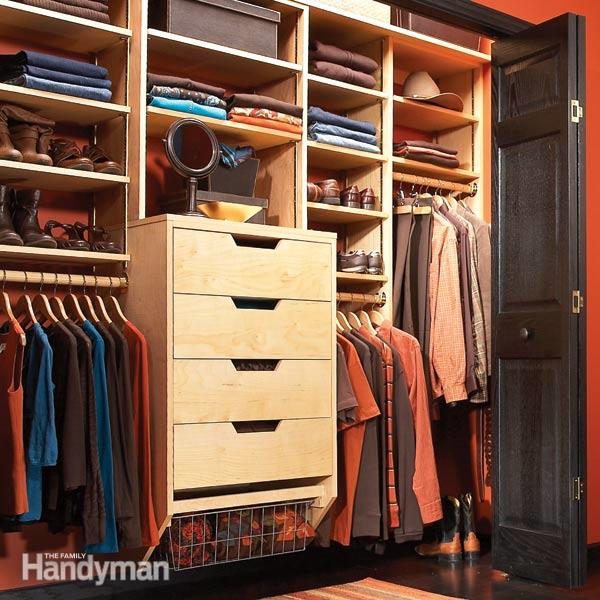
Using this simple design, you can build storage drawers for any size closet.
If you have to dig through a mountain of clothes to find your favorite sweatshirt, it’s time to organize your closet. This DIY built-in system organizes your closet with a shelf, drawer, and hanging space for your clothes, shoes, and accessories. This closet storage system is designed to help eliminate clutter. It would cost you hundreds of dollars to buy one of these at the home improvement store, but you can build this one for a lot less.
Our closet storage system is really just four plywood boxes outfitted with a closet rod and shelf system along with drawers. You can build drawer dividers to add even more organization.
We built it for an eight-foot-wide closet with an eight-foot ceiling, but it’ll work in any reach-in closet that’s at least six feet wide if you adjust the shelf width between the boxes or change the box dimensions.
Tools Required
Air compressor
Air hose
Brad nail gun
Circular saw
Clamps
Cordless drill
Countersink drill bit
Framing square
Hearing protection
Jigsaw
Level
Miter saw
Orbital sander
Paint tray
Paintbrush
Safety glasses
Self-centering drill bit
Stud finder
Utility knife
Materials Required
1-5/8-in. trim screws
1/2 in. plywood
1/4-in. plywood
3/4-in. birch plywood
wire basket
Wood glue
Project step-by-step (12)
Step 1
Why We Used Plywood
If you’re wondering whether plywood is good enough for this closet storage project, furniture specialist Spencer Lee would like a few words:
“Plywood is not just “good enough” — it’s strategic. In closet storage projects where strength, stability, and precision are critical, cabinet-grade plywood outperforms MDF and particle board (and even wood) on every front that matters.
Plywood’s cross-laminated construction resists warping and sagging over time, especially under the weight of loaded shelves. That is not just a durability win — it is a safety and performance issue. Unlike solid wood, it handles humidity shifts without cracking or cupping, which is crucial in closets that often lack climate control. The strength-to-weight ratio also makes it ideal for vertical supports, especially when you want slim profiles without sacrificing integrity.”
Closet storage cutting diagrams
This shows only the 3/4-in. plywood. The 1/2-in. and 1/4-in. plywood sheets are for the drawers and back.
Family Handyman
Family HandymanFamily Handyman
Step 2
Cut the plywood down to size
Start by cutting all the parts to size. The corner box sides are slightly narrower than 12 inches, so you can cut off dings and dents and still cut four sides from a sheet of plywood.
You won’t be able to cut the shelves that fit between the boxes to length until the boxes are installed (the shelves need to be cut to fit), but you can rip plywood to 11-7/8-in. and cut the shelves to length later.
Once the parts are cut, apply edge banding (iron-on veneer) to all the edges that will be exposed after the boxes are assembled.
Build a jig to hold the parts upright. Place a part in the jig, then cut the edge banding so it overhangs each end of the plywood by 1/2 in.
Run an iron (on the cotton setting) slowly over the edge banding. Then press a scrap piece of wood over the edge banding to make sure it’s fully adhered.
Complete DIY projects like a pro! Sign up for our newsletter!
Step 3
Finish now, save time later
Pre-finishing gives you a faster, neater finish because you’ll have fewer corners to mess with. As Lee puts it: “Here is the industry rule of thumb that rarely makes it into casual DIY tips: if it’s harder to reach with a brush once it’s installed, it’s too late to do it right. Once shelves and vertical supports are in place, your angles for brushing or spraying become cramped. You end up rushing, overloading the brush, or skipping spots entirely.”
He continues: “Raw plywood is like a sponge; if left unfinished after assembly, it absorbs ambient moisture unevenly, which can lead to subtle swelling or surface fuzz that throws off the fit or feel of the storage system. Early sealing locks in dimensional stability.”
Lightly sand the wood and your closet rod with 120-grit sandpaper. Wipe away the dust with a tack cloth, then use a paint pad to apply a coat of polyurethane on everything except the drawer parts. Lee recommends a coat of sanding sealer before you apply polyurethane to even out absorption and keep the finish coat sitting proud, not blotchy. “That’s a small step that makes a big difference in the pro look of the final piece,” he says.
An inexpensive pad will let you finish each part in about 20 seconds. Let the finish dry, then scuff between coats.
Family Handyman
Step 4
Preinstall drawer slides
Attaching drawer slides is a lot easier if you do it before the boxes are assembled.
Position the slides using reference lines and a spacer. Remember that there are left- and right-hand slides, usually marked “CL” and “CR.”
Family Handyman
Step 5
Gang-cut the standards
Cutting 16 standards one by one with a hacksaw would take hours. Instead, bundle two or more together with tape and cut them in bunches.
You can cut them with a hacksaw, but an easier way is to use a metal blade in a jigsaw. Place two or more standards together so the numbers are oriented the same way and the standards are aligned at the ends. Tape the standards together where you’re going to make the cut, then gang-cut them with your jigsaw.
Family Handyman
Step 6
Install the drawer slides
It’s easier to install the drawer slides and the shelf standards that go inside the boxes before you assemble the boxes.
Use a framing square to draw reference lines on the drawer unit sides for your drawer slides.
The slides are spaced eight inches apart, centered 8-3/4-in. down from the top of the box. Keep the slides 3/4-in. from the front edge (this is where the drawer faces will go).
Use a 7/64-in. self-centering drill bit to drill pilot holes and screw the slides into place.
Attach the glides for the basket three inches below the drawer slides. If your basket is narrower than 22-1/2-in., screw a cleat to the box side so the basket will fit.
Step 7
Attach the shelf standards
Now attach the shelf standards.
Screw the standards to the inside of the box sides, one inch from the edges.
Keep the standards 3/4-in. from the top (that’s where the box tops go).
Be sure the numbers on the standards are facing the same way when you install them—this helps ensure the shelves will be level.
Step 8
Tack the boxes together
If you have a brad nailer, first tack the boxes together to hold the parts in position then add one-inch screws for strength.
Use 1-5/8-in. trim screws because the screw heads are small and unobtrusive (we left the screw heads exposed). Here are some tips for assembling the boxes:
Attach the screw strips to the box tops first, then add one side, then the bottom shelf, and then the second side.
Drill 1/8-in. pilot holes to prevent splitting. Stay an inch from the edges.
If your cuts are slightly off and the top, bottom, and sides aren’t exactly the same width, align the front edges.
The boxes will be slightly wobbly until they’re installed in the closet, so handle them with care.
The middle bottom box has a back. Square the box with the back, then glue and tack the back in place.
After the corner boxes are assembled, screw shelf standards to the side that doesn’t abut the wall (it’s easier to install the standards before the boxes are installed).
Family Handyman
Step 9
Square the drawer boxes
To square the drawers, set adjacent sides against a framing square that’s clamped to your work surface.
Glue and tack the drawer bottom into place.
Then set the drawer slides on the drawers, drill pilot holes, and screw the slides into place.
If the boxes aren’t square, the drawers won’t fit right or glide smoothly.
Family Handyman
Step 10
Center the drawer faces
Getting the drawer faces in their perfect position is tricky business. If the faces are even slightly off-center, the drawer won’t close properly.
To align them, install the drawers in the box and place double-sided tape over the drawer front.
Starting with the top drawer, center the drawer face in the opening.
You should have about an eighth-inch gap on both sides and the top.
Press the face into the tape, then take the drawer back out and clamp the face to the drawer to keep it stationary.
Drive two one-inch screws through the inside of the drawer into the face.
Family Handyman
Step 11
Hang the corner boxes
Now install the boxes.
Start by drawing a level line in the closet, 11 inches down from the ceiling. This will give you just over 10-in. of storage space above the closet system after the top shelf is installed.
Then mark the stud locations on the wall with tape.
Don’t assume your closet walls are plumb—they’re probably not. So you can’t just place a box in a corner without checking for alignment.
Align the top of the box with your level line on the wall.
Have your helper plumb the box with a level while you drive 2-1/2-in. screws through the screw strip into the wall at the stud locations.
Attach the other corner box the same way.
Family Handyman
Step 12
Install the shelves and drawers
Find the center of the wall, then make a mark 12-in. on one side of the center mark. That’s where your shelf unit will go.
Again, have your helper plumb the box while you align it with your marks and screw it to the wall.
Prop up the drawer unit on spacers so it’s tight against the shelf unit.
Align the edges, then clamp the boxes and screw them together. Drive screws through the screw strip into the wall.
Next, place the top shelf over the boxes.
Pro tip: We could just barely fit our shelf into the closet to lift it into place. If yours won’t fit, you’ll have to cut it and install it as two pieces. Make the cut near one end, over a corner box, so it’s not noticeable.
Once it’s in place, screw the shelf to the box tops with 1-1/4-in. screws.
Attach shelf standards along the sides of the shelf and drawer units.
Cut the adjustable shelves to length to fit between the corner boxes and the middle boxes.
Finally, screw the closet rod flanges into place, cut the closet rod to size and install the rods.
Family Handyman
FAQ
How can I make a small closet more efficient?
Besides building a closet storage system, you can employ one or more of these strategies:
Maximize the use of vertical space by adding shelves and hangers;
Start by decluttering and giving away items you don’t need. Consider turning this into an ongoing routine. Then establish a system for organizing the items you keep into categories, and stick to it. If you don’t want to build a closet storage system, consider buying one. Finally check out these closet storage hacks to help keep your closet organized.
About the Expert
Spencer Lee is an interior designer and furniture specialist. I am the Founder of Lakeland Furniture, based in the UK.
We are no longer supporting IE (Internet Explorer) as we strive to provide site experiences for browsers that support new web standards and security practices.



 Time
Time  Complexity
 Cost
Cost