When felling a tree, it is imperative that you take the necessary precautions (and avoid these no-nos) to keep you and the structures around you safe.
Focus and proper techniques are the key points when you are thinking about cutting down a tree on your own. Follow all the necessary safety tips and use the proper instruments and techniques to do this easily.
Top Tree Cutting Mistakes to Avoid
Cutting down a tree can be a complicated task. It requires careful planning, and there are some tree cutting mistakes to avoid. Safety protocols are important because they can prevent major accidents.
One of the mistakes is called the barber chair. According to the University of Georgia, “Barber chair occurs when the force pulling forward on the trunk is great enough to split the trunk but not great enough to trigger the hinge to fold. It is often caused by heavy, front-leaning trees. It can also occur by applying too much force to a rope while pulling the tree over when using mechanical advantage.”
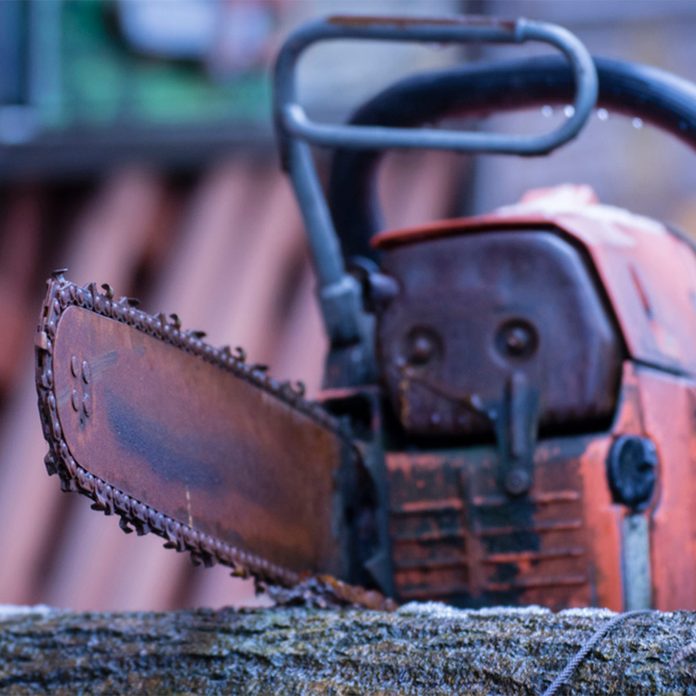
Another mistake is using old gear. If you are using a chain saw, make sure there is no rust on the chain. If it has rust on it, it could break during the cutting process and harm you.
Tree Cutting Safety Tips and Tools for Every Homeowner
Choose the right tools and always follow tree cutting safety tips. If you are planning to cut down a tree, you need to assess the tree’s height and lean. Always check the surrounding hazards, like power lines and nearby small to large structures.
It is also crucial to clear the adjacent areas of the tree. Create a 45-degree escape route so when you cut down a tree, you have a path in the direction the tree will fall.
1/15
Family Handyman
Don’t forget safety gear
When you are using a chain saw and cutting a tree, safety is the most important thing. One of the most common reasons for tree removal is not having safety gear when cutting down a tree. You can use special chaps, which can stop a running chain and help prevent dangerous accidents. A helmet will protect your ears, eyes and head. Steel-toed shoes are also recommended.
ⓘ
2/15
Lapis2380/Shutterstock
Don’t use a chain saw that should be retired
Cutting down a tree is not an easy task. You need proper, functional tools…. preferably tools that were built in the last decade or so and have been well-maintained. Always use a well-conditioned chain saw.
3/15
Family Handyman
Don’t work alone
You’ll be a lot safer if you have a trusted assistant standing a few feet behind you, watching the top of the tree for falling branches and letting you know when the tree starts to fall. Have your assistant tap you on the shoulder with a stick to alert you when it’s time to vacate the area.
4/15
Shannon Matteson/Shutterstock
Don’t just wing it
Do your research on how to cut down a tree safely. And before you even start your saw, stand back and size up the situation. Think about how you’ll cut each branch and what will happen when you do.
5/15
PannrayS/Shutterstock
Don’t lean your ladder against a tree
It might be tempting to lean a ladder against a tree to do some pruning. Don’t do it. This stunt accounts for a large percentage of chain saw injuries.
6/15
Pam Walker/Shutterstock
Don’t run out of oil or gas
Tree cutting is a difficult and high-risk job. You need to follow the proper tree felling do’s and don’ts to avoid any kind of serious situation. Fill the gas and chain oil reservoirs before dropping a tree. The last thing you want is to run out of gas in the middle of a felling cut.
7/15
Family Handyman
Don’t lose your grip
Never take either hand off of a running saw. If the saw kicks back, there’s nothing to stop it. Use an encircling grip with your thumbs wrapped around the handles.
8/15
Kerstin/Shutterstock
Don’t try to cut down a rotten tree
Leave rotten trees to the pros. If the heart of the tree is rotted out, the felling direction can be extremely unpredictable. In addition, it most likely has many dead limbs above that just might shake loose and land on you during cutting.
9/15
jerryjoz/Shutterstock
Don’t use a dull chain saw
We’ll show you how to sharpen a chain saw, making the job of cutting down a tree much easier.
10/15
Family Handyman
Don’t forget to recheck chain tension
Before starting, check the chain tension. Recheck it after every hour or so of use and adjust it if necessary. Generally, new chains can expand. You need to be aware of this and check the chain after 20 minutes or so of use. Loose chains can create a problem and can fly off the bar, causing serious injuries. The driver’s bar can also be damaged due to the loose chain.
11/15
Sebastian Knight/Shutterstock
Don’t DIY around power lines or near structures
If there’s even a small risk that you won’t be able to fell a tree away from power lines or structures around your house, it’s not worth it to DIY. Hire a pro.
12/15
Family Handyman
Don’t cut in the kickback zone
This spot, called the kickback zone, is the top half of the bar’s tip. If the kickback zone comes in contact with something while the chain is moving, the saw will kick up and back toward you. That’s why modern chain saws are equipped with a chain brake designed to stop the chain if a kickback occurs.
13/15
Family Handyman
Don’t pinch the saw
When cutting up your felled tree into smaller pieces, the saw can become pinched if you cut too far through a branch that supports the trunk. If this happens, stop the engine and use a stout branch as a lever to lift the trunk and free the saw.
14/15
Family Handyman
Don’t cut the ground
When cutting up a felled tree, avoid touching the ground with the chain because even a brief encounter will severely dull the cutting teeth on your chain saw. If possible, cut partially through the tree and then rotate it to cut the rest of the way through.
15/15
Family Handyman
Don’t leave the stump
If you want to remove a stump, you can rent and use a power stump grinder. You can also buy it from the online or offline market. Alternatively, a can of tree stump remover can be used to do this. Almost every stump killer is made of potassium nitrate. It will help to speed up the decomposition process. After pouring the granules, fill it with water. You will see spongy roots after four to six weeks. Now, you can easily break the wood.
Sources:
ResearchGate: “Causes and Environmental Effects of Tree Removal on the University of Ibadan Campus”
HSE: “Case studies: Terms and practises used in forestry and arboriculture”
We are no longer supporting IE (Internet Explorer) as we strive to provide site experiences for browsers that support new web standards and security practices.