


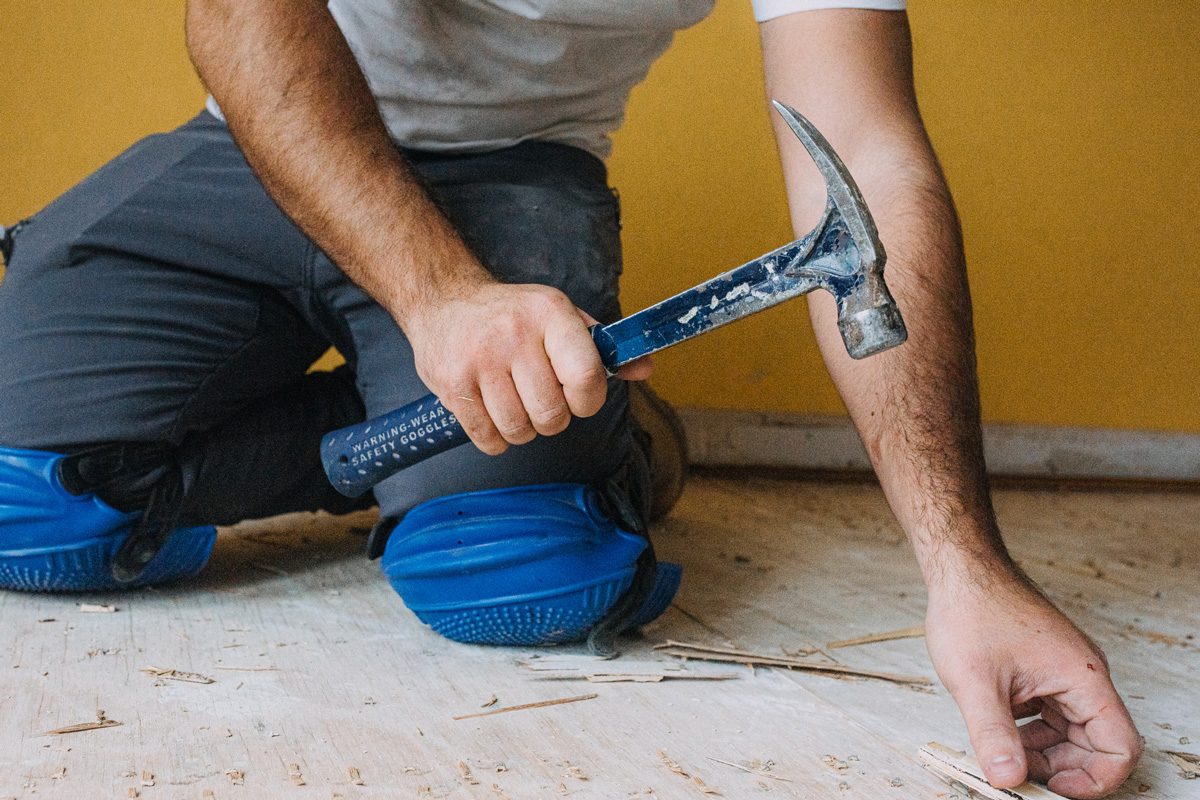
The humble hammer is a go-to for most home improvement projects. But did you know it can do more than just pound nails? See what else this good ol’ tool can do.
1
/
12

Lumber Splitter
The claw serves as a mini-axe to split wood blocks or chop off protruding board edges.
2
/
12

Homemade Hammer Mallet
Cover a metal hammer with a tennis ball to protect the surfaces of your projects when you knock them together or apart. Carefully cut an ‘X’ in the ball with a sharp utility knife. Make it just large enough for the head of an 18- to 24-oz. hammer to slide through. You’ll discover that your rubber bumper hammer works better than a standard rubber hammer because it concentrates the blow on a small area and doesn’t leave black marks.
3
/
12

Hammer Extension
When you need to extend the reach of your hammer to get into a tight spot, the hinge pin from an old, heavy door hinge makes a great punch.
4
/
12

Measuring Stick
If you can remember the length of your hammer, it can be a handy measuring device. If you think you’ll have a tough time remembering that figure, grab a marker and write it down on the bottom of your hammer’s handle.
5
/
12

Maximize Your Hammer Power
Ram the claw of your hammer into the nail shank and rock it sideways using the claw edge as a pivot point. Repeat the process until you pry out the nail. This technique produces maximum pulling power with little stress on the handle.
6
/
12

Caulking Gun for Airheads
The hammer handle makes a decent caulking plunger when you really need to push out another dab or two.
7
/
12

Safer Trim Nailing
Push the nail into a thin strip of cardboard to hold it in position while nailing and to shield the wood from an errant hammer blow.
8
/
12

Give Paint-Clogged Screw Heads a Tap
If you live in an old house, you’ve probably run into screw heads clogged with layers of paint. Instead of trying to scrape out the paint, try this trick: Simply take a driver bit, set it on top of the screw head, and give it a couple of taps with a hammer until it seats itself in the screw’s slots.
9
/
12

Handy Nail Holder
When working with small nails or in tight quarters, keep your fingers out of the line of fire with the help of a hair accessory. A bobby pin is perfect because it can grip even the smallest nails and it provides plenty of distance between your fingers and the hammer.
Place the nail inside the bobby pine. Then, use the bobby pin to hold the nail in place and hammer away. Once the nail is started, you can remove the bobby pin and continue hammering.
This hint also works with an index card. Simply press the nail through a corner of the card and hold it where you need it. Start hammering and then tear the card off of the nail.
10
/
12

Avoid Ugly Hammer Marks
Nails are easier to drive if you take a full swing. But the downside is that if you miss the nailhead, you’ll leave a deep ‘elephant track’ in the decking. Use a 1/4-in. plywood cushion to protect the deck boards in case you miss with a hammer. This will allow you to concentrate on nailing without worrying about denting the deck boards. Simply start the nail. Then, slip a small square of 1/4-in. plywood over the nail and swing away. Remove the plywood for the last blow.
11
/
12

Blade Straightener
Bend those out-of-shape blades on a reciprocating saw back to an almost-straight condition. Straighten it out with the claw or you could also lay the blade flat on a 2×4 and beat it.
12
/
12

Bonus Tip: Quick-Draw Storage
Here’s an instant rack for hammer storage! Drive 2-in. drywall screws into a board and tack it to a shop wall. Hook the hammers on the screws so it looks like they’re ready to pull out a nail. The hammer claw’s V-notch interlocks tightly with the screw threads so the hammer won’t fall off, and the handle angles toward you for an easy grasp.


