


Here is a simple but helpful summary of what the IRC code says about the standard stair rise and run, plus key nosing requirements.
The Right Standard Stair Rise and Run for Your Home

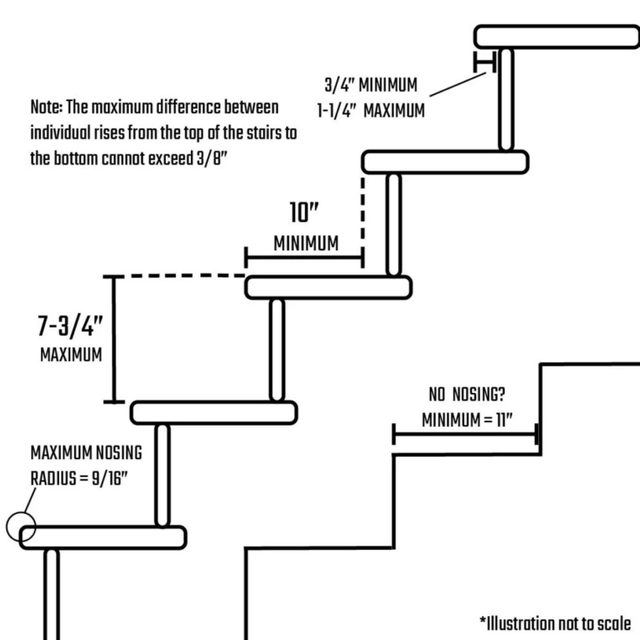
To build stairs that feel safe and easy to walk on, you need to get the details right. The standard stair rise and run is not just about following rules. It’s about creating steps that feel consistent, comfortable and secure every time you use them.
The International Residential Code (IRC) has specific instructions on the way stairs can be built. Here’s a clear summary of what the IRC code says about stair codes for rise, run and nosing.
(Note: not every municipality adopts every part of every code, and some cities and states add in their own additional rules. Bottom line, check with your local building official before cutting those stringers or forming that stoop.)
On This Page
What Is Standard Stair Rise and Run?
The term “standard stair rise and run” refers to the vertical and horizontal dimensions between steps:
- Rise: The distance between two treads that goes up and down.
- Run: The distance between the front of the tread to the back of your foot.
These measures are very important for using stairs safely. If the rise and run are not right, stairs might be hard to climb or even dangerous.
Think of well-designed stairs as a rhythm—each step should feel smooth and predictable underfoot. That’s the result of properly calculated rise and run.
IRC Stair Code Requirements: Rise, Run and Nosing
To build safe, code-compliant staircases, the International Residential Code (IRC) provides clear stair code requirements for residential structures. These include exact rise and run measurements that make sure each step is the same and easy to use. Meeting these requirements not only keeps people safe, but it also keeps you from breaking the law and having to pay a lot of money. We will go over the IRC’s most important regulations for stair rise, tread depth and nosing below. These are important measurements that any homeowner or contractor should know before starting a stair project.
IRC stair rise requirements
According to IRC guidelines, the maximum rise or the vertical height between two consecutive stair treads must not exceed 7-¾ inches. This standard helps ensure a comfortable and consistent climbing experience. Uneven risers can pose serious staircase safety risks, especially for older adults and children.
IRC stair run requirements
The run is the measurement of the tread, which needs to be a minimum of 10 inches if the tread has an overhang on it (see image). These rise and run measurements are taken from the nose of one tread to the nose of the next. You are not required to have a nosing or overhang on your stair treads. But if your stairs don’t have a nosing, you are required to have a tread that is at least 11 inches long.
Riser height variances
From the top to the bottom of a staircase, the height variation between the tallest and shortest risers must not exceed 3/8 of an inch. This tight tolerance is in place to prevent tripping hazards caused by inconsistent step heights.
IRC stair nosing requirements
The nosing on treads, believe it or not, has a code minimum and maximum of how far the nosing projects over the next stair. Nosings are required to overhang a minimum of ¾-in. to a maximum of 1-¼-in. Also, the maximum nosing radius cannot exceed 9/16 of an inch. These nosing rules not only support a clean stair appearance but also contribute to staircase safety regulations by improving tread visibility and grip.
Remember to include flooring
All of these measurements include the finished flooring, so don’t forget to take those thicknesses into account when planning your stair dimensions.
Here are three reference numbers for the codes pertaining to rise, run and nosing in a straight run of stairs:
R 311.7.5.1
R 311.7.5.2
R 311.7.5.3
Step-by-Step Guide to Measuring Stair Rise and Run
To make sure your stairs are safe and meet building codes, you need to measure the rise and run of the stairs correctly. The following pointers will show you how to make sure your stairs fulfill building codes and have the right rise and run measurements.
- Measure the Total Rise: To begin, measure the overall vertical distance from the finished floor at the bottom of the steps to the finished floor at the top. This is the entire rise.
- Determine Ideal Riser Height: To get the number of risers you desire, divide the overall rise by that number. The IRC says that each riser can only be 7¾ inches high at the most. Change the number of risers as needed to stay in this range. Example: 96 inches of total rise ÷ 13 risers = 7.38 inches per riser (acceptable).
- Measure the Total Run: To find the desired tread depth, multiply the number of treads (one less than the number of risers) by the number of treads. If there is nosing, the tread depth should be at least 10 inches. If there isn’t, it should be at least 11 inches.
- Check Consistency: Make sure that all of the risers and treads are the same size. The IRC says that the whole staircase can only be off by 3/8 inch at most. One of the main reasons people trip is because the sizes of things don’t match up.
- Factor in Flooring and Nosing: Always take into account the thickness of any completed flooring materials when you do the math. If you’re adding a nosing, make sure it sticks out between ¾ inch and 1¼ inches and has a radius of no more than 9/16 inch.
Bonus Tip: Make a full-size model of your layout or utilize stair calculator tools to see how big the stairs will be before you cut the materials.
If you know how to measure stairs correctly, you can make sure that your steps meet both the basic rise and run requirements and the most important safety rules for stairs.
FAQ
Can I adjust stair dimensions for steep areas?
Yes, you can change the size of the stairs a little bit for hilly areas, but they still have to follow building codes. You can add more steps to lower the height of the riser, or you can utilize alternating tread designs in small spaces like attics. You must always follow the rules for the rise and run of stairs, unless municipal codes say otherwise.

