


Clean up problem stains faster and easier with these expert tips.
Welcome to Family Handyman’s Guide to Gorgeous Floors, where you can find all the essential tips and tricks for achieving the floors of your dreams and keeping them looking good as new for years to come.
Sheet vinyl “resilient” flooring is so easy to clean that it may never require anything beyond damp mopping with a cleaner intended for vinyl floors. But if your floor has marks or stains that still won’t come off, you can use stronger stuff.
Although the methods described here won’t harm most vinyl floors, we strongly recommend that you test them in a closet or on a section of flooring that’s hidden by furniture. Use white rags only; chemicals that dissolve stains can also make fabric colors bleed and stain your floor. Ahead, find our best tips to remove tough stains from vinyl flooring with expert advice from Marie LaFleche of ST Floor Covering.
Methods to Remove Stains from Vinyl
There are several products that can remove tough stains from vinyl, but each one’s effectiveness will vary depending on the stain type.
Isopropyl alcohol
Isopropyl alcohol is a mild solvent sold as a disinfectant at drugstores. It’s the best cleaner for heel marks and works well to remove other tough stains on vinyl, like ink and grease-related stains. You can also use lighter fluid or mineral spirits. Remember that all these products are flammable; turn off any nearby pilot lights and hang rags out to dry before throwing them away.
Oxalic acid
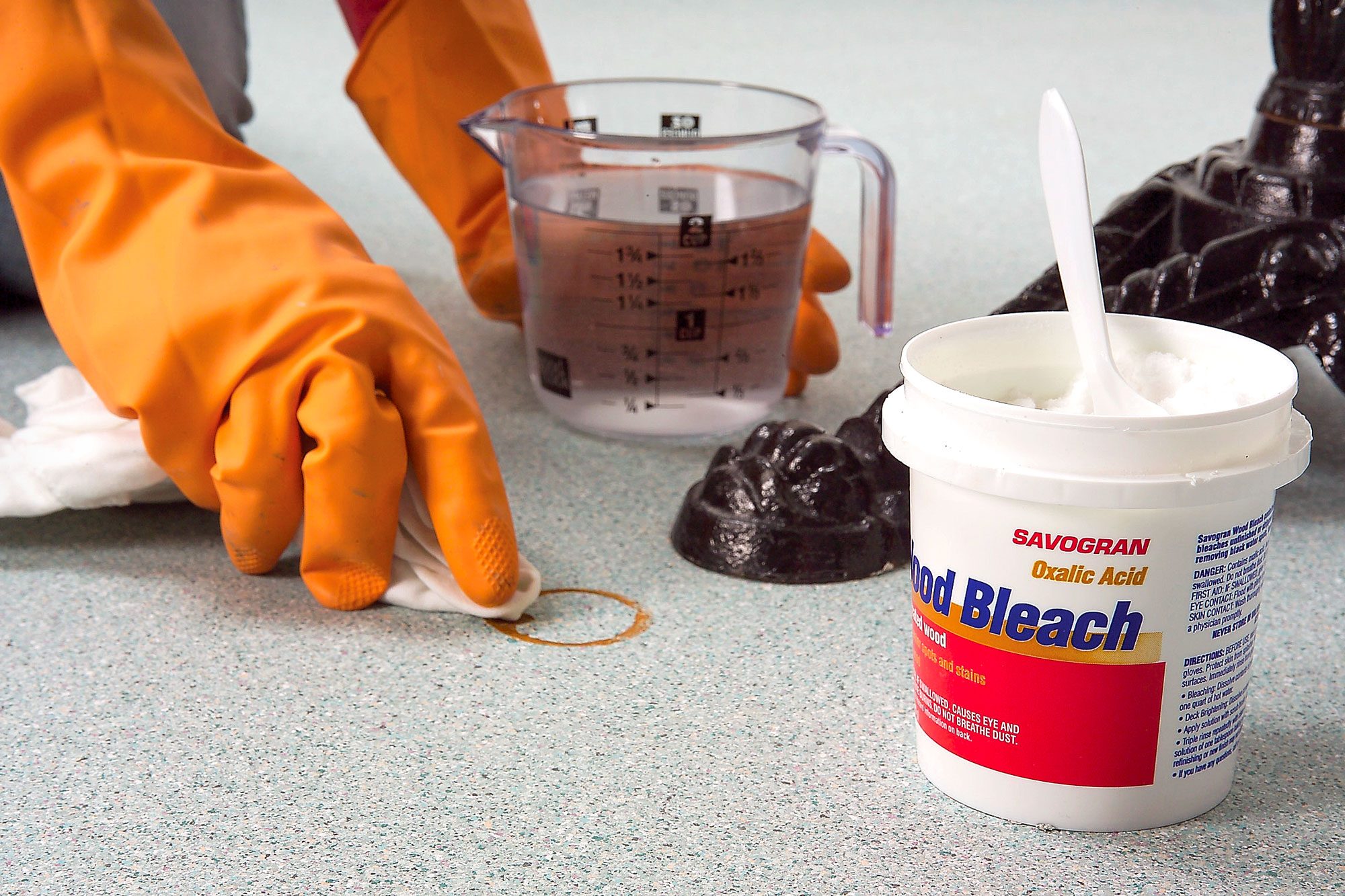
Oxalic acid is the solution for stubborn rust stains and other organic stains like mold and mildew. It’s often labeled “wood bleach“— but not all wood bleach contains oxalic acid, so check the label. Most paint stores and some hardware stores carry oxalic acid.
If the stain doesn’t rub off, wet a rag with the acid solution and lay it over the stain for 10 minutes. If the stain remains, rewet the rag and repeat. When that’s done, rinse the floor with clean water.
Baking soda
Baking soda works well to remove food and beverage stains as well as mold and mildew stains. Combine baking soda and water to create a paste, then apply it to the stained area with a soft-bristle brush or rag. Let it sit for 10 to 15 minutes, then scrub gently in a circular motion until the stain is removed.
Hydrogen peroxide
This common household product is a mild oxidizing agent that can be safely used on many surfaces, including vinyl. Mix a 1/2-cup hydrogen peroxide with 1 to 2 tsp. dish soap, stirring gently to avoid excess suds. The soap helps to break the surface tension of the peroxide to absorb into the material. Add a small amount to the stain, scrub it in lightly and let it sit until dry, then wipe away with a clean cloth. If the stain has lightened, repeat until the stain is lifted, then wipe clean with water and a rag.
Nail polish remover
For very stubborn stains like permanent marker, try nail polish remover, which contains acetone, a strong solvent. Acetone by itself is too strong to use on vinyl, but the amount found in nail polish remover can be used safely, but still use caution. Dampen a clean cloth with nail polish remover, then gently rub it on the stained area. Do not apply too much pressure, and stop to check periodically for damage. When finished, rinse with water and wipe with a clean rag.
How to Fix Stains That Can’t Be Removed
If you’ve tried all the above methods and the stain remains, consider more drastic action to keep your flooring looking good.
Replace damaged planks or tiles
If your vinyl flooring consists of planks or tiles, LaFleche recommends removing the damaged piece and replacing it with a new one. “This is what we do, especially in commercial settings where they don’t want to spend a lot of time dealing with stains. Instead, just remove the tile or plank and put down a new one.”
For click-lock floating floors, you can unlock the floor starting from the corner of the room, remove the stained plank, replace it, and then reinstall the rest of the flooring. For peel-and-stick vinyl, simply peel up the stained tile and replace it with a new piece.
Patch sheet vinyl
For sheet or glued-down vinyl, LaFleche recommends cutting out the stained section and patching in a replacement piece. “We try to cut a piece from a closet or other out-of-the-way place and seam seal it as a replacement,” she says. You can also cut a patch from any leftover flooring, if you have it.
Cut a patch slightly larger than the stain, lay it over the damaged area, and use a straight edge and utility knife to cut through both layers. Remove the stained piece, apply vinyl adhesive to the back of the patch, and press it into place. Seal the edges with a thin line of seam sealer, wipe away any excess, and let it dry completely. Be sure to use a sealer made for your specific type of vinyl.
How to Prevent Stains on Vinyl Floors
Prevention is key when it comes to tough stains on vinyl flooring. Start by carefully maintaining your floors to keep the top wear layer in good condition. If this layer becomes scratched, worn or damaged over time, liquids can seep through and cause stubborn stains. Keep your floors swept and mopped, put felt pads under furniture legs and use area rugs in high traffic areas to prevent scratches and general wear. Promptly clean any spills as well before they have a chance to become stains.
Properly sealing seams and edges during installation is also essential to prevent moisture from getting underneath vinyl, causing stains that are difficult or even impossible to remove.
FAQ
Are stains harder to remove from vinyl?
Stains on vinyl floors are not likely confined to the surface or wear layer, but have permeated into the flooring layers, making them very difficult to extract and remove.
What chemicals should I avoid cleaning vinyl with?
Avoid using ammonia-based cleaners, bleach and pure acetone on vinyl floors as these can quickly damage, discolor or melt the wear layer.
About the Expert
- Marie LaFleche is the office manager at ST Floor Covering in West Springfield, Massachusetts. She has over 12 years of industry experience.